

Varishtha Pension Bima Yojana (VPBY) which was launched government on 15/08/2014 is soon going to close on 14/08/2015. Varishtha Pension Bima Yojana is a pesion secheme which is giving a return of 9% per annum if pension is opted in monthly mode and 9.38% when opted for yearly mode. Minimum amount for investment in VPBY is Rs. 63960, Rs. 65430, Rs. 66170 and Rs. 66665 for yearly, half yearly, quarterly and monthly mode respectively and miximum amount which can be invested in Varishtha Pension Bima Yojana (VPBY) is Rs. 639610, Rs. 654275, Rs. 661690 and Rs. 666665 for yearly, half yearly, quarterly and monthly mode respectively.
All you need to know about Pradhan Mantri Atal Pension Yojana (PMAPY)
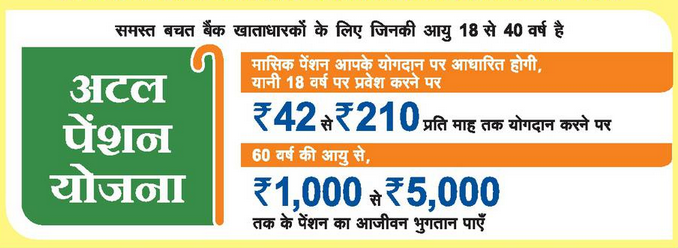
There are many people in India working in unorganised sectors with no guarantee of any pension at old age. Though government had launched Swavalamban Yojana in 2011-2012, a very less people joined the scheme as it did not provide any certainty of amount payable at vesting age.
To provide financial security to such people at older age government has announced the Atal Pension Yojana (APY), which will provide a defined pension, depending on the contribution, and its period. The APY will be focussed on all citizens in the unorganised sector, who join the National Pension System (NPS) administered by the Pension Fund Regulatory and Development Authority (PFRDA). Under the APY, the subscribers would receive the fixed minimum pension of Rs. 1000 per month, Rs. 2000 per month, Rs. 3000 per month, Rs. 4000 per month, Rs. 5000 per month, at the age of 60 years, depending on their contributions, which itself would be based on the age of joining the APY.
Increase in service tax on insurance premium from 01/06/2015

It was proposed in in Union Budget 2015 to increase the service tax from 12.36% to 14%. After the Notification No. 14/2015-Service tax dated 19/05/2015 by the government, new servic tax will be effective from 01/06/2015. All the Service including the insurance premium will be dearer from 01/06/2015. The special rates for life insurance service … Read more
Difference between PMSBY and PMJJBY

Lots of People are asking about the difference between the Pradhan Mantri Suraksha Bima Yojana (PMSBY) and Pradhan Mantri Jeevan Jyoti Bima Yojana (PMJJBY). In this article I have tabulated the difference between both the schemes. Both the Schemes are available to the customer through their banker with auto debit of premium from their bank … Read more
All you need to know about Pradhan Mantri Suraksha Bima Yojana (PMSBY)
Pradhan Mantri Suraksha Bima Yojana (PMBSY) is a Accidental Insurance scheme and renewable year to year. Under this scheme people between age of 18 to 70 years will get a accidental risk cover of Rs. 200000 by paying just a premium of Rs. 12 per year. If the life assured dies due to accident his/her … Read more
All you need to know about Pradhan Mantri Jeevan Jyoti Bima Yojana (PMJJBY)
On May 9, 2015 Prime Minister of India is going to launch the Pradhan Mantri Jeevan Jyoti Bima Yojana (PMJJBY) to provide insurance cover to masses with minimum premium, this insurance cover can be taken from any bank by filling out a simple form. Minimum requirement is that you should have a bank account and aged between 18 to 50 years. One can only take maximum cover of Rs. 200000 from any of the his banker if having multiple accounts in different banks, and have to give declaration about the same in the form. Other features are as follows:
Which company to choose to buy Term Insurance Plan

Term Insurance Plans are the best plans to cover risk of life. Term plans not only provide high risk cover but with less premium in return. With increase in the Insurance companies premium for term plans differ very much. Difference in the premium can be double between lowest to highest, this puts the person taking insurance in dilemma of which company is best to take Term Insurance Plans.
Nomination in a Life Insurance policy

Nomination is a right conferred by the section 39 of the Insurance Act 1938, on the “holder of a policy of life assurance on his own life” to appoint a person/s to receive the policy moneys in the event of the policy becoming a claim by the assured’s death. The term “holder of a policy” ordinarily means a … Read more