

Assignment in life insurance is the legal process through which the rights, title and interest in a life insurance policy are transferred from the existing policyholder (assignor) to another person or institution (assignee).
Assignment in life insurance is an important concept for life insurance policyholders because an assigned policy can be used for purposes such as obtaining a loan, transferring policy rights to another person, creating financial security for a lender, or transferring ownership for a specific purpose.
In India, assignment in life insurance policy is governed principally by Section 38 of the Insurance Act, 1938, as amended from time to time. LIC also recognises assignment and provides for both absolute assignment and conditional assignment.
This guide explains what assignment in life insurance means, how it works, the different types of assignment, when an LIC policy can be assigned, what happens to nomination after assignment, and the procedure for assigning an LIC policy.
Table of Contents
What Is Assignment in Life Insurance?
Assignment in life insurance means the transfer of rights, title and interest in a life insurance policy from one person to another.
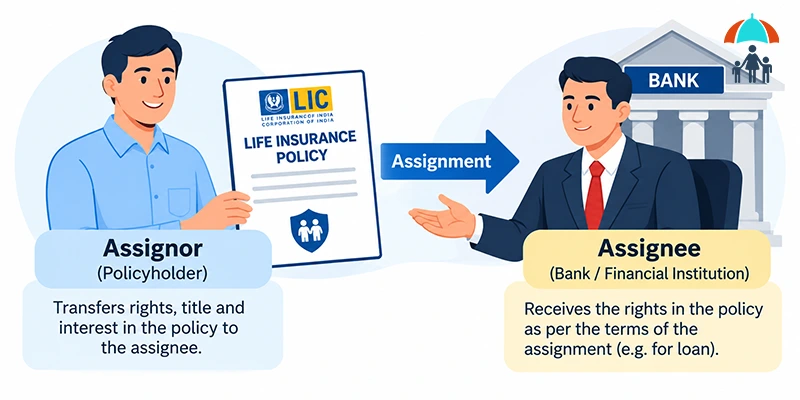
The person who transfers the policy is called the Assignor, while the person or institution receiving the rights is called the Assignee.
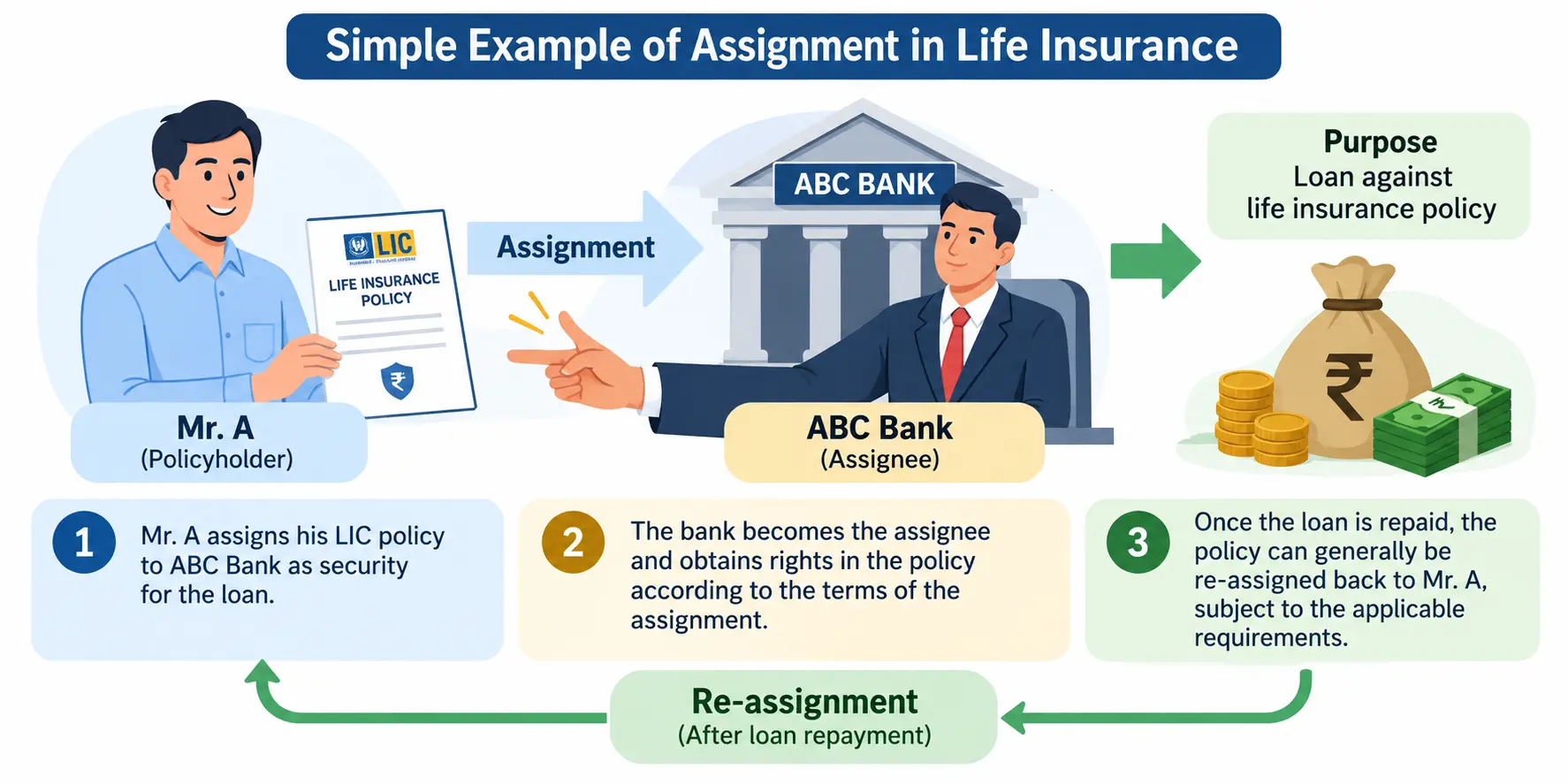
For example, suppose Mr. Raj has an LIC policy and wants to take a loan from a bank against the policy. He may assign the policy in favour of the bank, subject to the applicable terms and requirements.
After a valid assignment in life insurance policy, the rights in the policy are transferred to the assignee according to the terms of the assignment.
LIC states that when an assignment is executed, the assignor gives up the rights, title and interest in the policy in favour of the assignee. Premium and loan-interest communications may thereafter be sent to the assignee.
Who Is an Assignor and Who Is an Assignee?
While doing an assignment in life insurance, understanding these two terms is essential.
Assignor
The assignor is the person who transfers the rights, title and interest in the life insurance policy.
Usually, this is the policyholder who has the right to assign the policy.
Assignee
The assignee is the person or institution to whom the rights and interest in the policy are transferred.
The assignee may, depending on the circumstances and terms of assignment, be:
- A bank
- A financial institution
- A spouse
- A close relative
- Another individual
- A trust
- An institution
- A public body
While executing the assignment in life insurance the exact eligibility and documentation requirements can depend on the policy, nature of assignment and applicable law.
Why is Assignment in Life Insurance used?
Assignment in life insurance can be useful in several situations.
1. Assignment in life insurance for a Loan
One of the most common uses of assignment in life insurance is to obtain a loan against a life insurance policy.
LIC’s customer guidance specifically states that when a policyholder raises a loan against the policy from LIC or another financial institution, the policy may have to be assigned to LIC or that financial institution.
For example:
Policyholder → Assigns policy → Bank/Financial Institution → Loan
Once the loan is repaid, the policy can be re-assigned to the policyholder, subject to the applicable procedure.
2. Transfer of Policy Rights
Assignment in life insurance can also be used when a policyholder wants to transfer rights in the policy to another person.
For example, a policy may be assigned to a spouse or close relative, subject to the applicable requirements and terms.
LIC provides forms specifically for certain conditional assignments in favour of a wife or close relative. Its current forms page lists Form No. 3838 for certain whole-life policies and Form No. 3837 for certain endowment or double-endowment policies.
3. Financial Security
An assignment in life insurance can provide security to a lender.
For example, when a bank gives a loan against an eligible life insurance policy, assignment gives the lender rights in the policy according to the assignment terms.
This is different from simply submitting a policy document as informal security. Assignment is a formal legal transfer of policy rights.
4. Special Financial Arrangements
Assignment in life insurance can also be used for certain special purposes where the policyholder wants another person or institution to receive specified rights under the policy.
However, assignment in life insurance should not be treated as a routine change of nominee. Assignment and nomination are legally different arrangements.
Types of Assignment in Life Insurance
There are two principal types of assignment recognized by LIC:
- Absolute Assignment
- Conditional Assignment
LIC’s policy conditions specifically identify these two types.
1. Absolute Assignment
An absolute assignment is an assignment in which the rights, title and interest in the policy pass to the assignee without a provision for automatic reversion to the assignor or the assignor’s estate.
In simple words:
Assignor → transfers policy rights → Assignee
The assignor no longer retains the rights that have been transferred through the assignment, subject to the terms of the assignment and applicable law.
Example of Absolute Assignment
Suppose Mr. A assigns his LIC policy absolutely to Mr. B.
After valid execution and registration/notice as required:
- Mr. B becomes the assignee.
- Rights under the policy pass to Mr. B according to the assignment.
- Mr. A cannot simply cancel the assignment on his own.
- If Mr. B later wants to transfer the policy rights back to Mr. A, a re-assignment may be required.
LIC specifically states that a validly executed assignment cannot simply be cancelled by the assignor by writing “cancelled” over the assignment. Re-assignment by the assignee is the mechanism through which the rights can revert to the original policyholder.
2. Conditional Assignment
A conditional assignment is an assignment in life insurance where the transfer is subject to a specified condition.
LIC describes conditional assignment as an arrangement under which the assignor and assignee may agree that, upon the occurrence of a specified event that does not depend upon the will of the assignor, the assignment may be suspended or revoked wholly or partly.
Example
Suppose a policy is conditionally assigned to a close relative subject to a specified event.
The assignment in life insurance may contain conditions determining what happens to the policy rights when that specified event occurs.
Therefore, the exact wording of the assignment is very important.
Absolute Assignment vs Conditional Assignment
The actual effect of an assignment depends on the policy terms, assignment document and applicable law.
What Type of Assignment Is Permitted in LIC Policies?
LIC recognizes both:
✔ Absolute Assignment
and
✔ Conditional Assignment
The availability of a particular form of assignment, however, depends on the policy, its terms and applicable law.
LIC’s official policy conditions state that assignments can be conditional or absolute.
LIC also provides specific assignment forms for certain conditional assignments to a wife or close relative.
Therefore, policyholders should not assume that every LIC plan can be assigned in exactly the same manner. The specific policy document and the servicing LIC branch should be checked before executing an assignment.
Can an LIC Policy Be Assigned for a Loan?
Yes, assignment in life insurance is commonly used when obtaining a loan against an eligible LIC policy.
LIC’s customer guidance states that if a policyholder raises a loan against the policy from LIC or another financial institution, the policy has to be assigned to LIC or the financial institution. LIC further states that after repayment of the loan, the policy is re-assigned to the policyholder.
For LIC’s own policy loans, LIC’s published policy conditions state that the policy is to be assigned absolutely in favour of the Corporation as part of the loan requirements.
What Happens to Nomination After Assignment?
This is one of the most important points that policyholders should understand while executing the assignment in life insurance.
Nomination and assignment are not the same thing.
When a policy is assigned, the existing nomination is affected. Know more about nomination here.
LIC states that, except where the assignment is made to LIC, nomination automatically stands cancelled upon assignment. LIC also states that for assignments made after 26 December 2014, a nomination that existed before assignment is automatically reinstated after re-assignment. For assignments made before that date, a fresh nomination has to be executed.
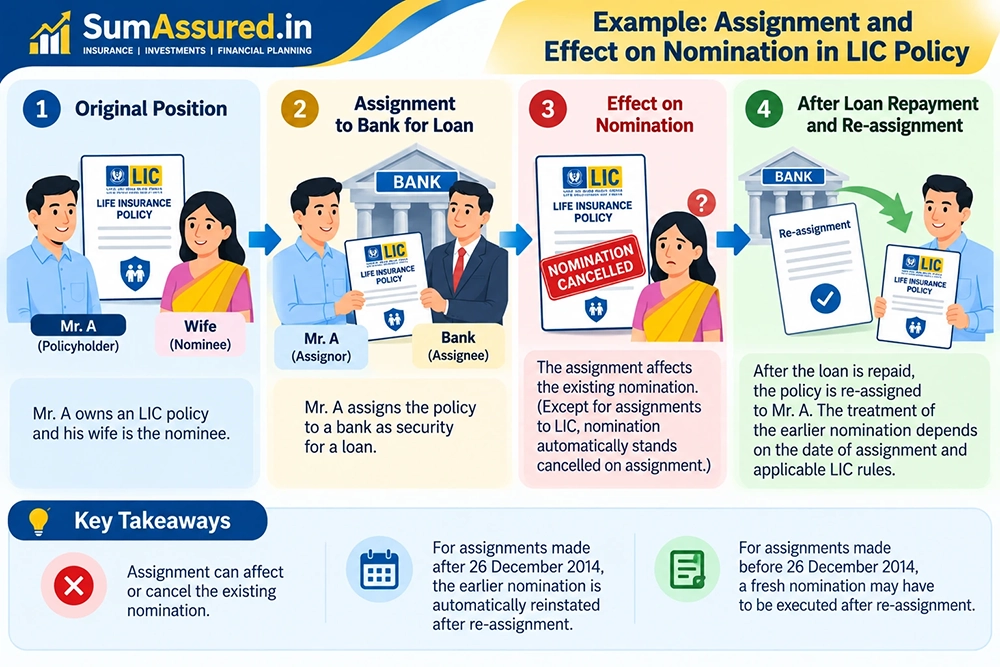
Because nomination and assignment have important legal consequences, policyholders should confirm the position with the servicing branch when completing reassignment.
Assignment vs Nomination: What Is the Difference?
These two terms are frequently confused. See the table given below to know the basic and important difference between the assignment in life insurance and nomination in life insurance.
Assignment vs Nomination: What Is the Difference?
Assignment and nomination are two different concepts in life insurance. They are often confused, but they serve different purposes.
Assignment is about transferring rights in a policy, while Nomination is about naming a person for receiving policy money in the circumstances specified by law and the policy.
Procedure for Assignment of an LIC Policy
The exact procedure may vary depending on the purpose and type of assignment, but the broad process is as follows.
Step 1: Check Whether the Policy Is Assignable
First, check the policy document and applicable policy conditions.
Not every policy or benefit arrangement should be assumed to have identical assignment provisions.
For an LIC policy, the servicing branch can confirm the applicable requirements.
Step 2: Decide the Type and Purpose of Assignment
Determine:
- Who will be the assignee?
- Why is the policy being assigned?
- Is it an absolute assignment?
- Is it a conditional assignment?
- Is it being assigned to LIC for a policy loan?
- Is it being assigned to a bank or financial institution?
The purpose and terms should be properly recorded.
Step 3: Obtain the Required Assignment Form/Instrument
The assignment may be made through an endorsement on the policy or a separate assignment instrument, as permitted under Section 38.
LIC provides assignment-related forms on its official website, including specific forms for certain conditional assignments.
Step 4: Complete the Assignment Document
The assignment document should contain the required details, which may include:
- Policy number
- Name of assignor
- Name and details of assignee
- Nature of assignment
- Purpose/reason for assignment
- Relevant terms and conditions
- Signatures
- Other information/documents required by LIC
Section 38 provides the legal framework for assignment/transfer and requires the assignment to be made through the prescribed form of endorsement or instrument.
Step 5: Sign the Assignment
The assignment must be properly executed.
Section 38 provides for execution through an endorsement on the policy or a separate instrument, signed by the transferor/assignor or duly authorised agent and attested as prescribed.
Step 6: Submit the Assignment to LIC
The assignment documents and required supporting documents should be submitted to the LIC office servicing the policy, unless LIC specifies another applicable process.
LIC’s customer guidance advises policyholders to approach the servicing branch for policy servicing matters.
Step 7: LIC Registers/Records the Assignment
The assignment must be properly communicated to the insurer and recorded in its records as required.
The legal framework under Section 38 provides that the assignment is not operative against the insurer until the required notice and assignment document/certified copy have been delivered to the insurer, subject to the statutory provisions.
Therefore, merely signing a document between two parties should not be treated as completing all insurer-facing formalities.
Step 8: Receive Acknowledgement/Endorsement
The policyholder should retain evidence that the assignment has been accepted/registered by LIC.
The original policy document and assignment documents should be kept safely because they may be required for future servicing, claims or reassignment.
Procedure for Assignment of an LIC Policy
The following steps provide a general overview of the process. The exact documentation and requirements may vary depending on the policy and nature of the assignment.
Check Eligibility of the Policy
First, check whether the LIC policy is eligible for assignment according to the applicable policy conditions and rules.
✓ Check applicable policy conditions
✓ Confirm assignment eligibility
Decide the Type and Purpose of Assignment
Determine why the policy is being assigned and whether the assignment is absolute or conditional.
Complete the Applicable Assignment Form
Obtain the applicable assignment form or instrument and fill in all required details correctly.
✓ Enter policy details correctly
✓ Provide required information
Attach Required Documents
Attach the documents required for the particular assignment.
Execute and Sign the Assignment
Ensure that the assignment is properly executed and signed by the parties as required.
Submit to the Servicing LIC Branch
Submit the completed assignment form and supporting documents to the LIC branch servicing the policy, according to the applicable procedure.
Get Acknowledgement and Confirmation
After submission, retain the acknowledgement and relevant documents for your records.
The exact documentation and procedure may vary depending on the policy and nature of the assignment. Always confirm the latest requirements with the servicing LIC branch before executing an assignment.
Documents Generally Required for LIC Policy Assignment
The exact requirements can vary according to the nature of assignment.
Depending on the case, LIC may require documents such as:
- Original policy document
- Assignment form/deed
- Identity and address proof
- Details/KYC of assignee
- Photograph, where applicable
- Loan-related documents in case of assignment to a bank/financial institution
- Authorisation documents where an authorised representative is acting
- Other documents prescribed by LIC
For a specific assignment, the servicing LIC branch should be contacted for the current document checklist.
How to Re-Assign an LIC Policy?
Re-assignment means transferring the policy rights back from the assignee to the original policyholder or another eligible person.
For example:
Policyholder → Bank
Assignment
Bank → Policyholder
Re-assignment
LIC states that an assignee may reassign the interest in the policy to the assignor during the policy term. Once the reassignment is executed on the policy document, the rights, title and interest revert to the assignor.
Common example: Loan repayment
Suppose a policy was assigned to a bank as security for a loan.
After the loan is fully repaid:
- The bank completes the necessary reassignment formalities.
- The reassignment is submitted/recorded with LIC.
- The rights in the policy revert as applicable.
- Nomination should be checked and updated/confirmed according to the applicable rules.
Can an Assignment Be Cancelled?
An assignor generally cannot cancel a valid assignment in life insurance simply by writing “cancelled” on the assignment document.
LIC expressly states that a validly executed assignment cannot be made ineffective merely by scoring it out or writing cancellation words over it. Re-assignment by the assignee is the mechanism for returning the rights to the assignor.
Therefore, assignment should be undertaken carefully.
Important Things to Check Before Assigning an LIC Policy
Before assigning your policy, check the following:
1. Understand what rights are being transferred
Assignment in life insurance can transfer significant rights in the policy.
2. Understand the purpose
Do not sign an assignment document without understanding why the policy is being assigned.
3. Check the type of assignment
Confirm whether the assignment in life insurance is:
- Absolute, or
- Conditional.
4. Check the effect on nomination
Assignment in life insurance can affect the existing nomination.
5. Keep copies of documents
Keep copies of:
- Assignment deed/form
- Policy document
- Submission receipt
- LIC acknowledgement
- Reassignment document, where applicable.
6. Check the policy after reassignment
After a loan is repaid and the policy is reassigned, verify that the policy records correctly reflect the current ownership/rights and nomination.
Important Legal Provisions Governing Assignment in life insurance
Assignment in life insurance policies in India is principally governed by Section 38 of the Insurance Act, 1938, as amended from time to time.
The statutory framework deals with matters including:
- Assignment or transfer of a policy
- Whole or partial assignment
- Assignment with or without consideration
- Assignment through endorsement or separate instrument
- Execution of the assignment
- Notice to the insurer
- Rights of the assignee
- Circumstances in which an insurer may decline to act upon an assignment
- Conditional assignments
- Re-assignment
The statutory provisions should always be read in their current form because insurance laws and regulations may be amended.
Is Assignment the Same as Selling an LIC Policy?
No.
Assignment in life insurance should not simply be described as “selling an insurance policy.”
An assignment in life insurance is a legal transfer of rights, title and interest under the policy. It may be made with or without consideration and may be used for purposes such as securing a loan or transferring rights to another person.
LIC’s official glossary describes assignment in life insurance as legal transference of the policyholder’s interest.
Frequently Asked Questions About Assignment
Here are answers to some of the most common questions about assignment of life insurance policies and LIC policy assignment.
01 What is assignment in life insurance? +
Assignment in life insurance is the legal transfer of rights, title and interest in a life insurance policy from the assignor to the assignee.
The assignor is generally the policyholder who transfers the policy rights, while the assignee is the person or institution receiving those rights according to the terms of the assignment.
02 What are the two types of assignment in life insurance? +
The two principal types of assignment are:
- Absolute Assignment – rights, title and interest are transferred to the assignee according to the assignment.
- Conditional Assignment – the assignment is subject to specified conditions.
The actual effect depends on the assignment terms, applicable policy conditions and law.
03 Can an LIC policy be assigned to a bank? +
Yes. Assignment is commonly used when an eligible life insurance policy is offered as security for a loan from LIC, a bank or another financial institution, subject to applicable requirements.
04 Can an LIC policy be assigned to a family member? +
Assignment to a family member may be possible depending on the nature of the assignment, the policy terms and applicable requirements.
LIC also provides specific forms for certain conditional assignments in favour of a wife or close relative. Policyholders should confirm the applicable requirements with the servicing LIC branch.
05 Does assignment cancel the nomination of an LIC policy? +
Assignment can affect the existing nomination.
According to LIC’s published guidance, except where the assignment is made to LIC, nomination automatically stands cancelled upon assignment.
The treatment of the earlier nomination after re-assignment depends on the applicable rules and the date of assignment. Therefore, nomination should be checked after the policy is re-assigned.
06 What is the difference between assignment and nomination? +
Transfers rights, title and interest in the policy to an assignee according to the assignment terms.
Names a person for receiving policy money in the circumstances specified by law and policy.
In simple terms, assignment is about rights in the policy, while nomination is about receiving policy money in the circumstances specified by applicable law.
07 Can an assignment be cancelled by the policyholder? +
A valid assignment cannot ordinarily be cancelled unilaterally by simply writing “cancelled” on the assignment document.
Where appropriate, the assignee may need to execute a re-assignment to return the rights to the original policyholder, subject to applicable requirements.
08 What is re-assignment of an LIC policy? +
Re-assignment means transferring the rights, title and interest in an assigned policy back from the assignee to the original policyholder or another eligible person, as applicable.
A common example is a policy assigned to a bank as security for a loan and subsequently re-assigned after the loan is repaid.
09 What is the procedure for assigning an LIC policy? +
The broad process generally involves:
- Checking whether the policy can be assigned.
- Deciding the type and purpose of assignment.
- Completing the applicable assignment form or instrument.
- Properly executing and signing the assignment.
- Submitting the required documents to the servicing LIC branch.
- Having the assignment recorded by LIC as required.
- Retaining the acknowledgement and relevant documents.
The exact documentation and procedure may vary according to the policy and nature of the assignment.
10 Can a life insurance policy be assigned partially? +
Section 38 of the Insurance Act, 1938 provides for assignment or transfer of a policy wholly or in part, subject to the applicable statutory and policy requirements.
Whether a particular LIC policy permits a specific form of partial assignment should be confirmed with LIC, considering the policy terms and circumstances.
11 Where should I submit an LIC policy assignment request? +
For LIC policy servicing, assignment documentation is generally submitted to the LIC branch servicing the policy, subject to the procedure applicable to the particular transaction.
It is advisable to confirm the current documentation requirements with the servicing branch before submitting the assignment.
12 Is assignment the same as selling an LIC policy? +
No. Assignment should not simply be described as selling an insurance policy.
Assignment is a legal transfer of rights, title and interest in the policy. It may be used for purposes such as securing a loan or transferring policy rights to another person or institution, subject to applicable requirements.
Assignment in Life Insurance: Key Takeaways
Assignment in life insurance is an important legal feature of a life insurance policy.
Remember these five points:
1. Assignment in life insurance means transfer of rights, title and interest.
2. The two principal types are absolute and conditional assignment.
3. Assignment in life insurance is commonly used for obtaining a loan against an eligible life insurance policy.
4. Assignment in life insurance can affect the existing nomination.
5. A valid assignment in life insurance cannot simply be cancelled by the assignor; re-assignment may be required.
Before assigning an LIC policy, policyholders should carefully read the policy terms and confirm the current documentation and procedure with the servicing LIC branch.
Official References
For the latest requirements and forms, policyholders should refer to the official LIC website and the applicable law.
- LIC Policy Conditions – Assignment and Re-assignment
- LIC Policyholder Guidelines – Assignment
- LIC Download Forms – Assignment Forms
- Insurance Act, 1938 – Section 38
This article is for educational and informational purposes only. Assignment of a life insurance policy has legal and contractual consequences. The actual rights, requirements and procedure may depend on the policy document, nature of the assignment, applicable law and the insurer’s current rules.
For an LIC policy, confirm the applicable requirements with the servicing LIC branch before executing an assignment.